
| Eastern Wild Olive |

|
 |

|


| File size | 1878265 |
| Original date | 7/23/09 8:29 AM |
| Resolution | 2592 x 1944 |
| Flash | Flash did not fire, auto |
| Focal length | 6.33mm |
| Exposure time | 1/640s |
| Aperture | 5.6 |
| Focus Distance | |
| Metering Mode | Multi-segment |
| Camera make | SONY |
| Camera model | DSC-T20 |
| Sensor type |
 |
 ative ative |
 |
 |
 |
Photo: |
Botanical name: Elaeocarpus floribundus Family: Elaeocarpaceae (Rudraksh family)
Eastern Wild Olive is an evergreen moderate sized tree
with spreading crown and clean bole
of 12-16 m length.
Leaves are ovate-elliptic, thinly leathery, varying from 6.5
x 3 cm to 19 x 8.5 cm, with a long pointed tip, and toothed margin. White
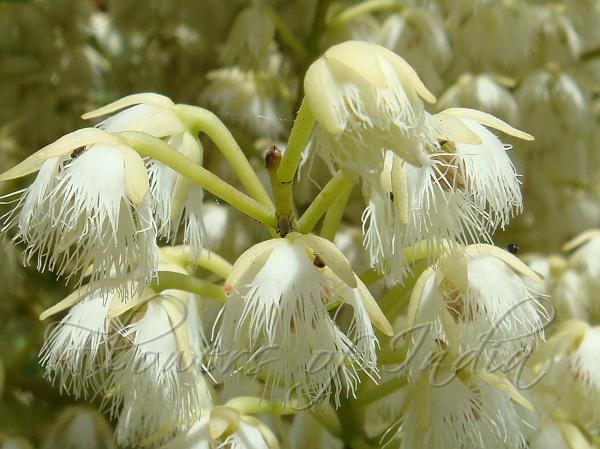
flowers are borne in many-flowered racemes, 2.5-12 cm long, in leaf axils.
Flowers are 5-merous, 0.5 cm long, comprising of 25 stamens, very interesting.
There are 5 sepals and 5 white petals which are divided into many frilly
segments. Fruit is light green drupe, 2 to 5 cm long and 1.5-2.5 cm in
girth. Both ends of fruit
are pointed, outer surface smooth having a mesocarp fleshy and pleasantly
acidic, edible. Stone -3 celled, each having a spindle shaped seed.
Eastern Wild Olive is often planted in home garden in NE India for its
fruits, which are used for pickle. It occurs in evergreen forests of
NE India, up to 1500 m elevation. Flowering: July-August.
Medicinal uses: An infusion of the bark and leaves is drunk as a tonic. An infusion of
the bark and leaves is used as a mouthwash for inflamed gums. The bark
and leaves are used in a poultice to treat ulcers.
An infusion of the bark and leaves is drunk as a tonic. An infusion of
the bark and leaves is used as a mouthwash for inflamed gums. The bark
and leaves are used in a poultice to treat ulcers.
Medicinal uses:
An infusion of the bark and leaves is drunk as a tonic. An infusion of
the bark and leaves is used as a mouthwash for inflamed gums. The bark
and leaves are used in a poultice to treat ulcers.
| Identification credit: Thingnam Sophia | Photographed in Imphal, Manipur. |
• Is this flower misidentified? If yes,